We may earn a commission from purchases through links in this article, at no extra cost to you. How we earn
Choosing a portable electric vehicle supply equipment (EVSE) cord comes down to two primary variables: your available electrical supply and the physical connector required by your vehicle. Portable chargers in the 3.5kW to 11kW range span single-phase 16A trickle-charging up to high-output three-phase 16A charging. Evaluating these units requires looking past marketplace titles to match listed kilowatt outputs, continuous amperage, and vehicle inlets with what your household or travel setup can safely accommodate.
Evaluation Methodology Note: This guide compares marketplace listings and supplied specifications without physical testing; no hands-on testing was performed on these products. Performance claims, pricing, and electrical capacities are based solely on published manufacturer specifications and retail listing data.
Core Power Tiers: Understanding Output and Phase Options
Portable EV chargers generally divide into three functional categories based on electrical delivery:
- 3.5kW to 3.6kW (16A Single-Phase): Designed for standard household or light utility circuits. These provide steady Level 1 or modest Level 2 charging rates suitable for plug-in hybrid electric vehicles (PHEVs) or overnight replenishment of typical daily commutes.
- 7.2kW (32A Single-Phase): The standard full-speed Level 2 mobile rate. Requires a dedicated high-amperage circuit and an appropriate heavy-duty receptacle.
- 11kW (16A Three-Phase): Utilizes three-phase alternating current power (widely deployed in European residential and commercial electrical systems) via industrial CEE plugs, delivering rapid Level 2 replenishment at lower individual line currents.
High-Power Portable Chargers
For drivers seeking faster recharge times away from stationary wallboxes, higher-output portable units provide either high single-phase amperage or three-phase distribution.
Feyree 11kW 16A Three-Phase Type 2 Portable EVSE
The Feyree 11kW unit is listed for three-phase electrical connections using a CEE supply plug and a Type 2 vehicle coupler. By distributing power across three 16A lines, it lists an 11kW transfer rate without demanding the heavier 32A wiring required by single-phase high-output chargers. The seller title lists a 5-meter charging cable alongside Wi-Fi and Bluetooth app capability. Because the listing provides no detailed description, buyers should verify what connectivity features the app actually supports, whether local Bluetooth or remote Wi-Fi access is enabled, and what mobile operating systems are compatible.
Target Use Case: Best suited for European or international drivers with access to three-phase industrial CEE receptacles whose vehicles are equipped with an onboard charger capable of accepting 11kW AC via Type 2.
Notable Drawback: Its utility is restricted by power infrastructure. Standard single-phase residential circuits cannot supply this unit without heavy electrical modifications, and at $182.10, it represents the highest price point among the compared models.

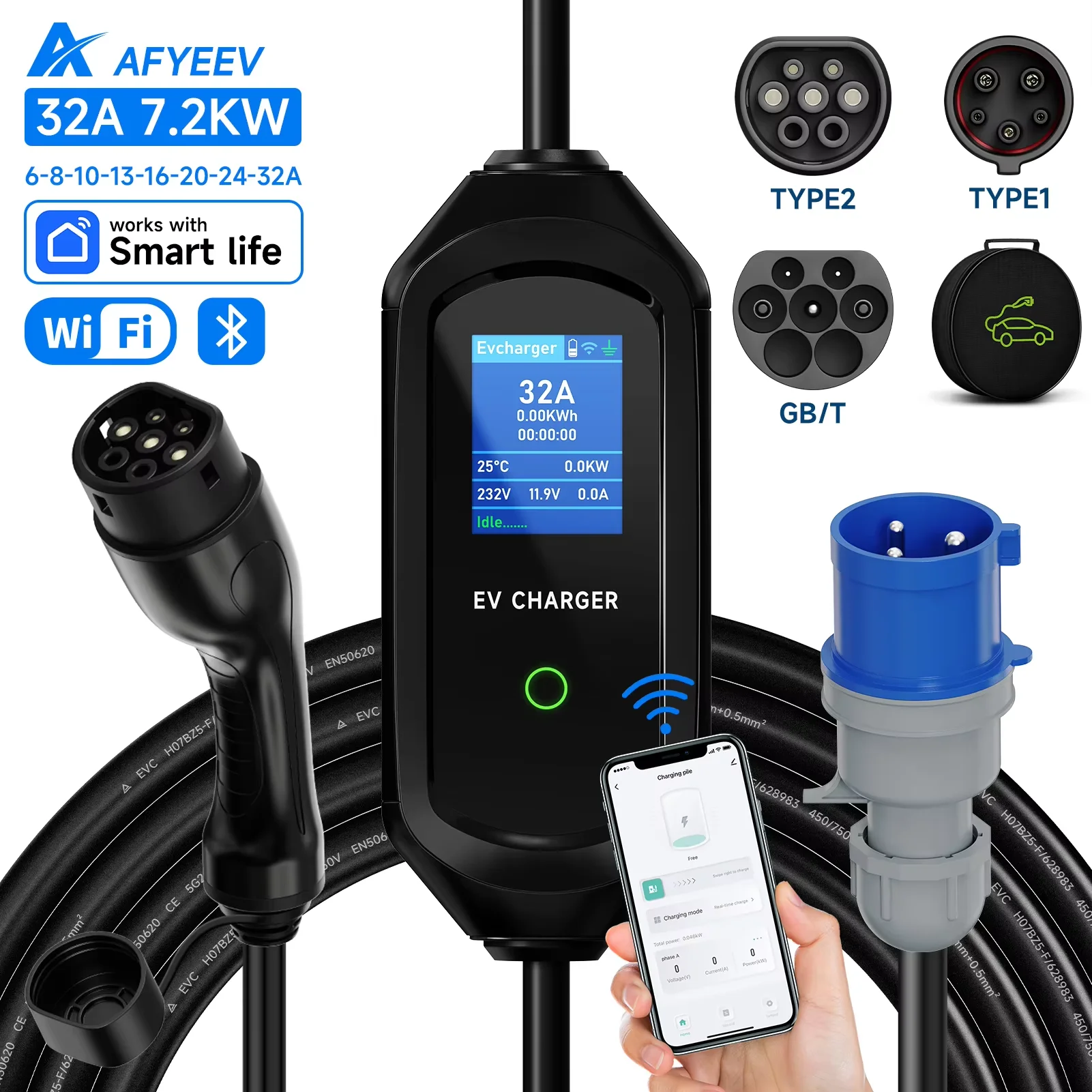
AFYEEV 7.2kW 32A Single-Phase Portable EVSE
For single-phase residential grids, reaching 7.2kW requires drawing up to 32A continuously. The AFYEEV 7.2kW unit lists this single-phase Level 2 charging rate, with marketplace title variants offering Type 1 (SAE J1772), Type 2, or GB/T couplers. The title also lists Wi-Fi and Bluetooth app control. Because the seller provides no detailed product description, buyers should check the listing to confirm whether the software supports charge status monitoring, timers, or energy tracking, and what setup is required to establish a wireless connection.
Target Use Case: Ideal for battery electric vehicle (BEV) owners who need faster single-phase overnight replenishment at home or travel destinations where a dedicated 32A industrial or RV-style outlet is already installed.
Notable Drawback: A continuous 32A draw requires a heavy-duty dedicated circuit and breaker. Plugging this unit into an improper or under-rated circuit presents a real electrical hazard, limiting spontaneous use in standard household wall outlets.
Lower-Amperage and Connector-Specific Options
When charging from lighter circuits or operating a vehicle with specific port requirements, compact 16A chargers offer lower installation demands and greater plug versatility.
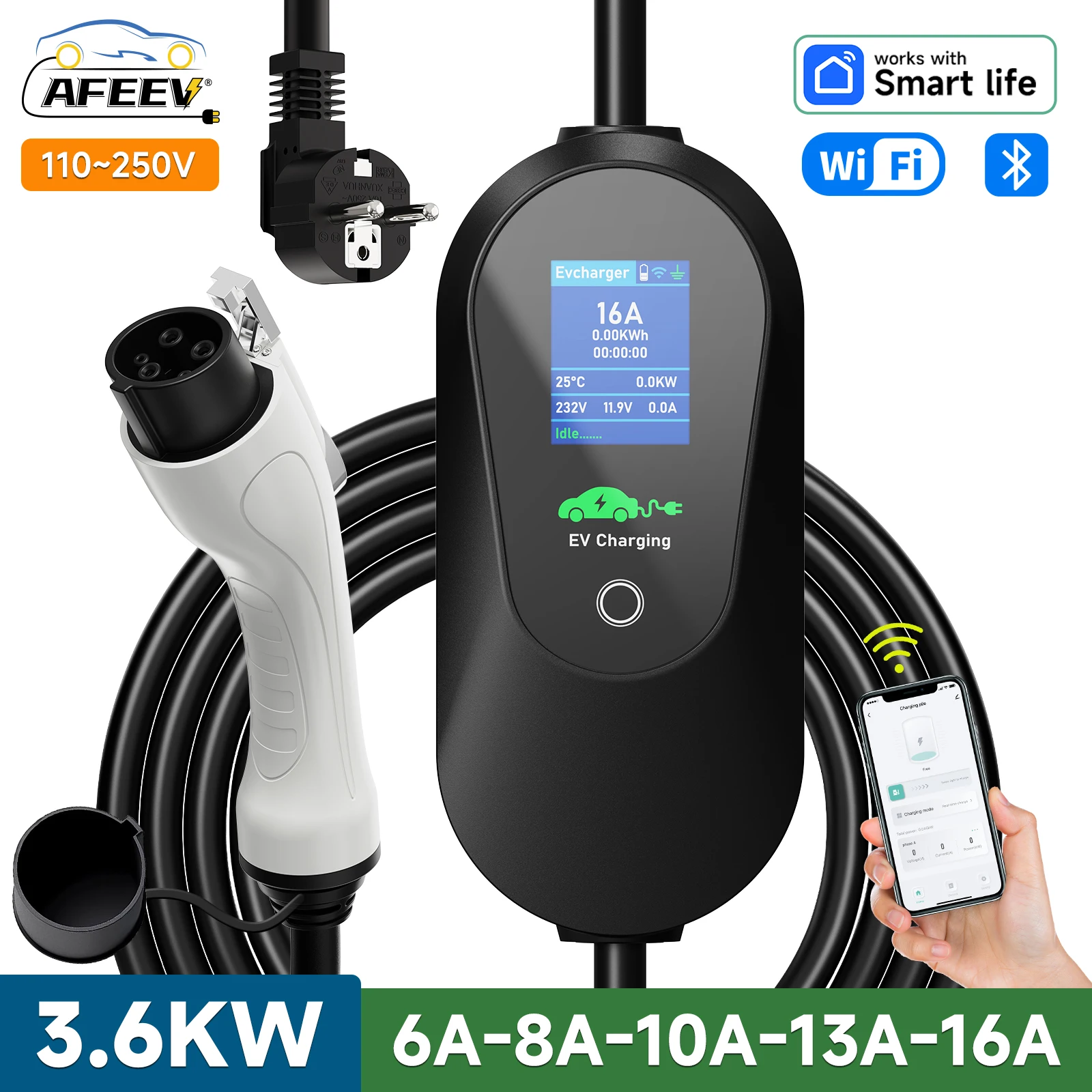
AFEEV 3.6kW 16A Multi-Standard EVSE
The AFEEV 3.6kW model operates at a listed 16A, delivering a manageable charging load that is friendlier to lower-capacity domestic circuits. Listed with options for Type 1 (SAE J1772), Type 2, and GB/T vehicle couplers, the title also lists Wi-Fi app control. Because the listing contains no product description, prospective buyers should check the listing directly to verify how the wireless connection functions, what app controls are provided, and whether remote monitoring requires a cloud account.
Target Use Case: Well-suited for plug-in hybrid owners, urban commuters with modest daily mileage, or travelers who need an affordable ($92.82) backup charging cable for lighter electrical circuits.
Notable Drawback: At 3.6kW, fully replenishing a large modern BEV battery pack requires extended charging sessions. Because the listing lacks a description of onboard hardware, buyers should also verify on the listing whether the control box features physical indicator lights or requires the smartphone application to monitor status.
Feyree 3.5kW Dedicated NACS Portable Charger
Unlike units requiring third-party adapters for North American Charging Standard (NACS) ports, this Feyree 3.5kW charger integrates a native Tesla-compatible NACS coupler. Operating at a listed 16A output, the unit advertises a 1.8-inch LCD screen and delay-scheduling capability. Because the listing lacks a technical description, buyers should verify on the listing what specific real-time metrics the display reports and how delay-schedule functions are programmed on the unit.
Target Use Case: Tailored for Tesla or NACS-equipped vehicle owners looking for a direct-plug portable travel cord for trunk storage, eliminating the need to attach separate physical adapters at destination stops.
Notable Drawback: Capped at 3.5kW (16A), charging rates are slower than dedicated high-amperage home wallboxes, and the proprietary NACS connector cannot service J1772 or Type 2 vehicles without additional coupler adapters.

Specification Summary Across Listed Models
| Model | Stated Output | Rated Current | Connector Types | Display / App Control (Listed) | Reference Price (USD) |
|---|---|---|---|---|---|
| Feyree 11kW | 11 kW (3-Phase) | 16A | Type 2 (CEE Supply) | Wi-Fi & Bluetooth App | $182.10 |
| AFYEEV 7.2kW | 7.2 kW (1-Phase) | 32A | Type 1, Type 2, GB/T | Wi-Fi & Bluetooth App | $124.60 |
| AFEEV 3.6kW | 3.6 kW (1-Phase) | 16A | Type 1, Type 2, GB/T | Wi-Fi App | $92.82 |
| Feyree 3.5kW NACS | 3.5 kW (1-Phase) | 16A | NACS (Tesla) | 1.8" LCD / Scheduled Delay | $111.32 |
Note: Prices and listed specifications reflect marketplace seller data at time of publication and are subject to change. Specifications represent seller-reported figures.
Practical Purchase and Electrical Considerations
Before selecting a portable EV charger, verify these critical points to ensure physical and electrical compatibility:
- Supply Circuit Capacity: A 32A charger requires a dedicated circuit rated safely above continuous load requirements under applicable electrical codes. Attempting to run a 32A charger on standard domestic wall sockets without proper wiring and circuit protection will trip breakers or create severe electrical hazards.
- Vehicle Onboard Charger Limits: An 11kW three-phase portable EVSE only delivers its rated power if your car's internal AC converter supports three-phase charging. Connecting an 11kW three-phase unit to an electric vehicle with a single-phase onboard charger limits replenishment to single-phase speeds.
- Receptacle Matching: Ensure the wall plug attached to the EVSE matches your socket. Three-phase chargers generally use industrial CEE connectors, while high-amperage single-phase units require specialized sockets rated for high continuous draw.
- Listing Selection Verification: Marketplace listings frequently group multiple coupler types (Type 1, Type 2, GB/T) under a single entry. Prospective buyers must confirm the exact plug variant selected in their cart before placing an order.